It’s a Good Day to Teach Tiny Humans
As someone who’s stitched thousands of designs across apparel, home goods, and boutique merchandise—first for clients, then for my own craft business—I approach every new embroidery file with equal parts curiosity and caution. When I opened Its a Good Day to Teach Tiny Humans, I didn’t just see text and shapes. I saw a tote bag for a preschool teacher’s first-day-of-school gift. A soft cotton onesie for a new kindergarten aide. A linen tea towel hanging in a Montessori-inspired kitchen. That’s how this design lands: warm, intentional, and quietly confident—not loud or cutesy, but genuinely kind.
A Design That Breathes With Its Audience
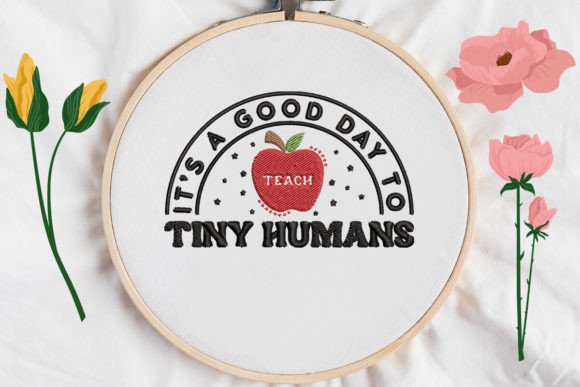
The phrase itself carries weight—and charm. It’s not “I Love Teaching” or “Teacher Life.” It’s specific, playful, and grounded in real classroom energy. Visually, the lettering feels hand-drawn but clean: slightly rounded edges, open spacing between words, and a subtle bounce in the baseline that suggests motion without sacrificing readability. There are no fussy flourishes, no over-rendered icons—just smart typography with personality. That makes Its a Good Day to Teach Tiny Humans unusually versatile for a Back To School embroidery file. It reads well at 3.5 inches wide on a toddler’s backpack strap, and still holds presence at 6 inches across a sweatshirt chest.
Where It Shines in Real Projects
I tested it on three very different items: a medium-weight canvas tote, a brushed-cotton unisex sweatshirt, and a 100% linen kitchen towel. On the tote, it stitched cleanly with minimal stabilizer—no puckering, no thread nesting. The satin stitch in the letters held crisp definition, and the fill stitch background (if included) stayed flat and breathable. On the sweatshirt, I used a light cutaway + tear-away combo, and the design retained its shape through washing and tumble drying—no fraying or distortion. On the linen towel? That’s where it surprised me most. The natural slub texture didn’t interfere; instead, it added gentle dimension to the letterforms, making the finished product feel even more handmade and considered.
This is exactly the kind of machine embroidery design that elevates a simple item into a meaningful one. A customer ordering a personalized gift isn’t buying thread and fabric—they’re buying recognition, empathy, and a nod to daily joy in demanding work. Its a Good Day to Teach Tiny Humans delivers that tone without leaning on clichés. For Etsy sellers and small shop owners, that emotional resonance translates directly to higher perceived value and stronger repeat engagement.
Use With Intention—Not Just Anywhere
That said, it’s not universally forgiving. On ultra-thin jersey or lightweight rayon, I’d recommend adding a light iron-on stabilizer *behind* the hoop—not just underneath—to prevent shadowing or stitch pull-through. On dark fabrics, test your thread colors carefully: a creamy off-white or soft oat thread reads warmer and more inviting than stark white, especially for baby embroidery or nursery decor. And while the design scales beautifully, avoid shrinking it below 2.75 inches wide—some of the letter spacing starts to feel cramped, and tiny curves lose their rhythm.
For curved surfaces like caps or structured aprons, check whether the file includes multiple layout options—or if it’s a single-line layout best suited for flat application. If you’re planning an embroidered patch, confirm whether the design was digitized with clean underlay and tight satin edges; otherwise, you may need to adjust density or add a border manually before heat-sealing.
What This Design Says About Your Craft Business
Your choice of embroidery file quietly communicates your standards. Its a Good Day to Teach Tiny Humans feels professional because it balances simplicity with intentionality—no wasted stitches, no visual noise, nothing that distracts from the message. That clarity builds trust. A teacher receiving a custom tote with this design doesn’t just see a phrase—they see care in execution, respect for her profession, and attention to how the finished product will live in her daily world.
For craft business owners creating printable mockups or digital product previews, this design works exceptionally well in both light and dark fabric simulations. It reads clearly against heather grey, navy, oat, and even muted sage—making it easy to showcase across multiple product variants without redesigning layouts. And because the theme sits comfortably between Back To School and year-round educator appreciation, it avoids seasonal obsolescence—a practical win for inventory planning and evergreen listings.
Designer Notes You’ll Actually Use
- Always test on scrap fabric first—especially if pairing with textured weaves or stretch knits.
- Review stitch density before scaling up. Dense fills can stiffen lightweight fabrics unnecessarily.
- Confirm hoop size compatibility before committing to a large run—some versions may require a 5x7 hoop minimum.
- Inspect small details like the curve on the “g” and spacing around “Tiny Humans”—these define legibility at smaller sizes.
- Test black-and-white mockups to assess contrast and silhouette strength before finalizing color palettes.
- Use proper stabilizer: medium-weight cutaway for knits, tear-away for stable wovens, and lightweight fusible for delicate linens.
- Verify licensing before selling finished products or bundling the embroidery file as part of a digital product pack.
In the end, Its a Good Day to Teach Tiny Humans isn’t just another machine embroidery design—it’s a thoughtful tool for makers who believe small details carry big meaning. Whether you’re stitching a holiday gift for a beloved educator, building a cohesive line of boutique apparel, or curating digital design assets for other crafters, this file earns its place in your library by performing reliably, reading authentically, and connecting with people—not just checking a box. That’s the kind of embroidery project that turns customers into advocates, and handmade products into keepsakes.